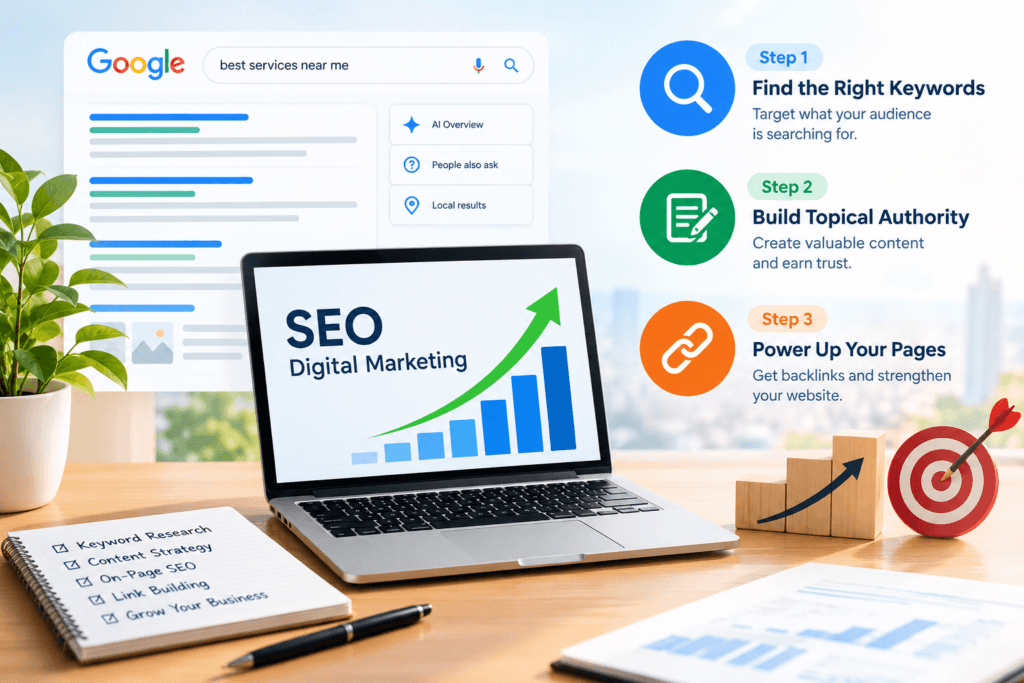
Ranking higher on Google is one of the main objectives for businesses that invest in online marketing. Yet, no competent SEO professional would commit to an absolute guarantee of #1 on the search engine results pages (SERPs). Dynamic algorithms, competitive landscapes, shifting user behaviors, and ever-evolving SERPs are just some of the challenges businesses must overcome.
What companies can do is set the stage for improved rankings by building technically proficient websites, publishing valuable content, becoming authorities on a topic, or earning links from reputable sources.
For businesses that seek reliable seo and digital marketing services, the focus should be on building a website that Google and potential customers will trust.
Step 1: Identify the Keywords That Can Help Your Business Grow
The first step in SEO involves identifying those words and phrases which can bring an organization new traffic, paying customers, and greater visibility.
Instead of focusing on hundreds of keywords, SEO professionals should begin by identifying which terms prospective clients might search for when looking for something that the business provides.
For instance, an organization offering plumbing services might be interested in keywords such as:
- plumber near me
- Houston plumber
- Drain cleaning Houston
- Water heater repair
- Sewer line repair
A software company could consider keywords related to the category their product falls into, whereas an eCommerce business would likely focus on items and categories. The organization’s brand name and the primary offerings should always be the foundation of a company’s keyword strategy.
Study the Search Results
Once the target terms have been identified, the next step involves searching for them on Google and analyzing the SERPs. Note that modern search results go beyond the traditional list of websites. Based on the search term, Google could return:
- AI Overviews
- Featured snippets
- Reddit discussions
- YouTube results
- Product listings
- People Also Ask
- Local results
- Comparison articles
- Service pages
- Business websites
This means that search intent should dictate the type of page that will be created. Before building a page, SEO professionals should always research what Google deems as the most relevant resource for the queried term.
For instance, if most results are service pages, it may not be the best idea to create an extensive guide. Similarly, if Google prioritizes comparison pages and detailed guides, the website should fulfill the search intent. It is always a good idea to review the search results and determine the following:
- What does the searcher need?
- What does Google consider to be the best solution?
Once the search intent has been identified, the next step is to build the page in such a way that it directly addresses the needs of the searcher. The objective is not to create the longest article; Google does not prioritize lengthy texts for every search term. Ask yourself the following question: What does someone searching for this keyword need to know, and have I addressed it sufficiently?
Match Your Content Formatting to Search Intent
The formatting of the page should align with the search intent and the type of result that Google deems the most relevant. As mentioned, a search for a commercial service could return multiple service pages. This means that the website should also have a high-quality service page. A search for a product could return product pages or comparison tools. The objective is to ensure that the website fulfills the search intent and offers a relevant experience.
However, it is important to note that the chosen format should not necessarily be a replica of the search results. Instead, the website should provide more information and better organization. For instance, Google often returns lengthy guides for informational searches, but a well-structured article created by the business can offer even more value to the prospective customer.
Any SEO content should aim to demonstrate the organization’s expertise and experience. For instance, a piece of content promoting a software product should be able to describe the tool based on the author’s personal or professional experience.
Step 2: Build Topical Authority and Website Trust
It is easy to overlook the fact that a well-crafted page may not always be sufficient, especially if the website has to compete with more established domains. This is the point where topical authority becomes increasingly important. A website that has multiple pieces of content about the same topic is more likely to rank higher than a competitor with a single page on the same subject.
For instance, imagine two websites that want to rank for a particular keyword. Both have created high-quality pages, but one company has ten pieces of content, whereas the other only has one. It becomes obvious that the former has demonstrated greater topical authority by having a repository of web pages that directly address the search intent.
Why SEO Is Not an Overnight Process
SEO is typically a continuous process that takes months and even years to bear meaningful results. Creating a compelling service page, publishing supporting content, and acquiring high-quality backlinks can help the website improve its rankings, but it is important to consider the following:
- Time: The time investment can vary greatly depending on the website’s industry, level of competition, technical specifications, and SERP performance, among other factors.
- Competition: Multiple companies will vie for the same spot on the SERPs, which means that businesses must always be on guard. Competitors will update their content, acquire backlinks, and improve their websites in an effort to improve their rankings. Consequently, an organization’s SEO efforts should prioritize continuous improvement.
Ranking higher on Google is never a guaranteed endeavor. Businesses must always focus on improving their services and products while also making their website more valuable and organized. For clients that wish to utilize our professional seo and digital marketing services , FVS Ondemand will focus on building a website that can organically grow its visibility.
How FVS Ondemand Can Help Businesses Grow Their Organic Visibility
For companies that want to build sustainable organic visibility, FVS Ondemand offers premier services that will analyze the market, identify opportunities, build compelling content, optimize the website, build internal and external links, and monitor the performance of the website so that it can continuously evolve. Our SEO strategy can include the following:
- Keyword and competitor analysis
- Search intent research
- Technical SEO
- On-page SEO
- Service page optimization
- Content strategy
- Content clusters
- Internal linking
- Local SEO
- Authority building
- Quality backlink building
- SEO performance monitoring
- Content optimization
The objective is to improve the website’s visibility in a manner that supports the business’s long-term growth objectives.